Why Defenses Get Strange
Predators turn survival into an engineering problem: an animal must buy time, create distance, or make its own body a bad target. Some species answer with familiar tools such as speed, camouflage, or teeth. Others deploy defenses that look bizarre because they exploit a narrow weakness in an attacker. A Texas horned lizard can send blood from tissues around its eyes toward a canid predator, while a sea cucumber can eject sticky Cuvierian tubules that tangle an attacker. The bombardier beetle mixes chemicals inside its abdomen and expels a hot, irritating pulse. These are not random tricks. Each links anatomy, timing, chemistry, and predator behavior.
The mechanisms also carry measurable costs. A study of Cuvierian tubules reported that discharged tubules may lengthen to about 20 times their original size before stiffening into a resistant adhesive network. In a 2004 study, experienced kit foxes largely avoided Texas horned lizards after encountering their blood defense, eating one lizard in eight later trials. Such observations show why an unusual display can work: it changes the predator's next decision, not merely the appearance of the encounter.
“Defense” covers more than a weapon. Playing dead, dropping a body part, releasing a foul secretion, or exposing a startling color can redirect an attack. The useful question is not which animal has the strangest feature, but what problem the feature solves and what limits keep it from being used constantly.
Problems Predators Create
A prey animal faces several threats at once. A stalking predator may defeat camouflage by smell. A fast pursuit can make flight impossible. A bite aimed at the head demands a response that works at close range, while a larger attacker may ignore a small bluff. That pressure favors layered defenses: a lizard may flatten its body and rely on horns before escalating to blood, and a sea cucumber may contract before ejecting material.
Energy and recovery make every defense a trade-off. Venom, blood, mucus, or digestive tissue takes time to replace. A bright warning display can attract a second predator. A chemical spray aimed poorly may waste a limited reserve or expose the prey's location. Even armor has a price in weight and movement. A defense succeeds when its cost is lower than the expected cost of being caught.
Popular descriptions often flatten these trade-offs. Horned lizards do not spray blood at every threat, and not every sea cucumber has Cuvierian tubules. A bombardier beetle does not make an explosion in the same sense as a bomb; it ejects a pressurized chemical secretion through a valve-like abdominal system. Accurate interpretation starts with the species, its predator, and the setting in which the behavior has been observed.
How Defenses Work
Turn Chemistry Into Distance
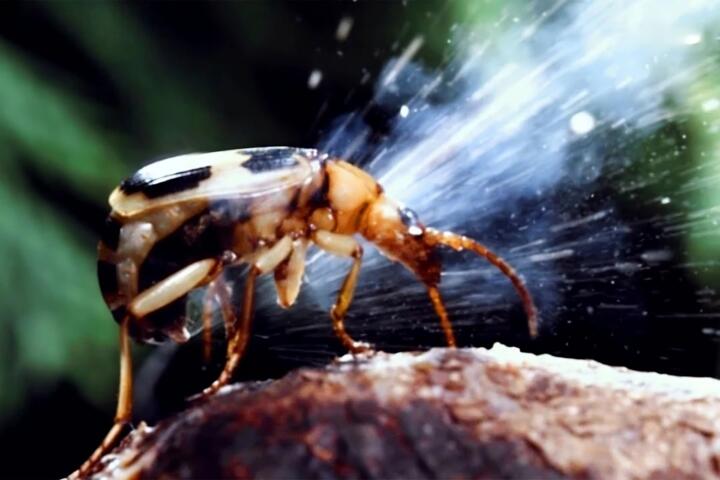
Bombardier beetles store separate chemical ingredients in abdominal reservoirs. When attacked, muscular contractions move them into a reaction chamber, where the mixture generates heat and pressure before discharge. A valve controls the pulse, so the beetle can direct repeated bursts toward an attacker. The spray irritates sensitive tissues and interrupts the predator's handling of the beetle. The design matters as much as the chemistry: separated ingredients reduce the chance of a premature reaction, and directional release turns a secretion into a close-range weapon.
The same principle appears in less dramatic forms. A skunk's sulfur-containing spray targets smell and irritation rather than injury. A millipede can release defensive compounds that make it unpleasant to seize. In each case, the prey does not need to overpower the attacker. It needs to make the next bite, swallow, or grip unattractive. A chemical defense works best when a predator learns quickly and the prey can retreat during the pause.
Make the Body Disposable
Some animals sacrifice a part of themselves to escape a grip. Many lizards shed the tail when a predator seizes it; muscles can keep the detached tail moving, drawing attention away from the fleeing animal. The cost is real: the replacement tail may differ in bone, color, and performance, and rebuilding tissue consumes energy. The tactic is therefore a last resort, not a routine response to harmless contact.
Sea cucumbers take sacrificial defense farther. Certain species expel Cuvierian tubules, organs attached near the respiratory tree, through the cloacal opening. In seawater the threads elongate and become adhesive, forming a sticky obstacle that can entangle a predator. Other species eject internal organs, a behavior called evisceration, and later regenerate them. These responses show why anatomy cannot be judged by human standards of intactness: losing tissue may be preferable to losing the whole animal.
Attack the Predator’s Senses
Texas horned lizards combine a spiny outline with a defense aimed at mammalian senses. Under attack by a canid, blood can be forced from sinuses around the eyes. The unfamiliar stream may startle the predator, but the chemistry appears to matter too. In experiments with coyotes, responses were stronger when horned-lizard blood or plasma reached oral or nasal membranes than when comparable material came from a related spiny lizard.
Fox trials point to learning as part of the mechanism. Researchers observed head shaking after blood squirts, then found that experienced foxes mostly ignored horned lizards in later encounters. The behavior is not a guaranteed shield: a hungry or inexperienced predator may continue, and the lizard still depends on camouflage, horns, and body posture. Its advantage comes from combining a visual surprise with an unpleasant taste or sensation.
Use Misdirection And Timing
Not every defense touches the predator. A killdeer may perform a broken-wing display, drawing an intruder away from a nest before flying off once the threat has moved far enough. Opossums can enter a rigid, unresponsive state that makes them less appealing to some predators, though the response is involuntary rather than theatrical acting. A prey animal gains time by exploiting a predator's decision rules: a moving parent may look easier to follow than hidden eggs, while a motionless body may seem dead or unprofitable.
Timing separates a useful bluff from wasted motion. A display used too early can reveal a nest or attract attention. Used too late, it may not interrupt a bite. Field observers therefore record the predator's identity, distance, weather, and sequence of behaviors instead of treating a single dramatic posture as proof of universal protection. The method is simple: identify the trigger, measure the predator's reaction, and ask what happens next.
Case Examples In Nature
Imagine an anonymized field observation of a Texas horned lizard crossing open ground. A kit fox approaches and grips the lizard's head region. The lizard first relies on its shape and horns, then releases blood. The fox shakes its head and drops the prey. That single encounter cannot establish a success rate, but it fits controlled work in which foxes later showed aversion. The lesson is narrow and useful: this defense appears tuned to canids, whose mouth and nose encounter the blood at close range.
Consider a second observation involving a sea cucumber on a reef. A fish or crab presses against the animal, which contracts and releases pale threads. The tubules stretch across the water and adhere to the attacker's appendages. The predator retreats, while the sea cucumber remains exposed and must rebuild what it lost. A researcher would record the species because tubule defenses vary among sea cucumbers. The encounter illustrates a recurring pattern: a soft-bodied animal turns vulnerability into a temporary barrier rather than trying to flee quickly.
Defense Choice Checklist
Use this checklist to compare a strange defense without assuming that the most shocking one is the best.
| Question | Chemical Spray | Sacrificial Tissue | Startle Or Bluff |
|---|---|---|---|
| What changes? | Taste, smell, or pain | The predator’s grip | The predator’s choice |
| Main cost | Limited chemical reserve | Recovery and regrowth | Risk of being ignored |
| Best setting | Close contact | A predator already holding prey | A visible but unfinished attack |
| What to verify | Target species and dose | Regeneration and survival | Predator reaction and timing |
For a responsible nature account, identify the species, cite the original observation or study, and separate a recorded effect from a popular claim. Ask if the behavior is automatic or controlled, costly or repeatable, and effective against all predators or only a narrow group. Those checks turn a strange anecdote into a defensible explanation.
Common Mistakes To Avoid
The first mistake is treating a spectacular defense as universal. A genus can contain species with different structures, diets, and predators. A claim about “horned lizards” may need a species name; a claim about “sea cucumbers” may need a note that only some possess ejected tubules.
The second mistake is confusing a defense with an attack. A bombardier beetle does not hunt with its spray, and a blood-squirting lizard is not poisoning every predator it meets. The behavior is conditional, usually triggered by capture, pressure, or a close approach.
A third error is repeating a number without its method. “Twenty times longer” describes sea-cucumber tubules under a particular mechanical study; it does not mean every released thread reaches that length in the field. Likewise, a small fox experiment can reveal a plausible response without predicting every wild encounter.
Finally, avoid human moral labels such as clever, cruel, or disgusting when they replace mechanism. Describe the tissue, trigger, target, cost, and observed outcome. That vocabulary keeps wonder while reducing exaggeration.
FAQ
Which animal sprays blood from its eyes?
Several horned-lizard species can eject blood from sinuses around the eyes, with the Texas horned lizard among the best-studied examples.
How does a bombardier beetle avoid burning itself?
It stores reactive ingredients separately and controls their movement into a reaction chamber before directing the hot secretion outward.
Do all sea cucumbers eject sticky threads?
No. Cuvierian tubules occur in some sea cucumbers, so the species and family must be checked before applying the description.
Can animals regrow sacrificed defenses?
Some can, including lizards that replace lost tails and sea cucumbers that regenerate expelled internal organs, though recovery takes energy and time.
Why do unusual defenses evolve?
They persist when a specialized response changes a predator’s behavior enough to improve survival despite its cost, limited range, or recovery burden.
Author's Insight
The strangest defenses are often precise solutions to precise predator problems. Blood works differently against a coyote than against a bird, and adhesive threads matter most when a slow animal cannot outrun an attacker. The strongest evidence combines anatomy with observed predator behavior, not a memorable description alone. Reading defenses this way reveals evolution as a series of trade-offs shaped by timing, tissue costs, and the senses of the enemy.
Key Takeaways
Wild defense mechanisms can shock, irritate, distract, trap, or sacrifice tissue, but their purpose is consistent: interrupt an attack long enough for survival. Bombardier beetles use controlled chemistry, some sea cucumbers deploy adhesive or expendable organs, and horned lizards exploit a canid’s reaction to blood. Their limits matter as much as their spectacle. A careful account names the species, identifies the trigger, reports the measured response, and avoids turning a specialized adaptation into a universal animal superpower.