Entropy Is Not Disorder
Entropy is a measurable quantity that tracks how many microscopic states are compatible with a system’s macroscopic description. In thermodynamics, it also tracks how energy spreads among available microstates when constraints change. In information theory, entropy measures uncertainty in a probability distribution. The same word appears in multiple fields, but the common thread is counting possibilities, not judging “messiness.”
The “disorder” label comes from early attempts to connect thermodynamics to everyday intuition. That intuition points toward something real: systems tend to evolve toward macrostates that correspond to more microstates. Yet “disorder” fails because it suggests a visual or aesthetic property, while entropy depends on the rules that define the system and what you choose to measure. Two states can look equally “ordered” to the eye and still have different entropy because their microstate counts differ.
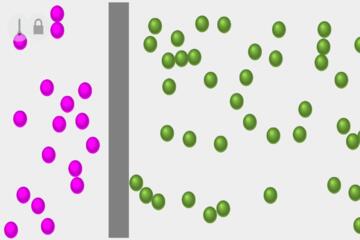
A practical example: consider two sealed containers connected by a valve, each initially holding a different gas. After opening the valve, the gases mix. The mixed state occupies far more microstates than the separated state under the same macroscopic constraints. Calling the result “more disordered” matches the intuition, but the real reason is statistical: the separated configuration is a tiny fraction of the microstates consistent with the same overall energy and volume.
Another example uses a deck of cards. If you shuffle thoroughly, you increase the number of micro-configurations that correspond to the same “macroscopic” description like “a random-looking deck.” Entropy rises because the probability mass spreads across many arrangements. The deck is not “disordered” in a moral sense; it is simply distributed across many possibilities.
Where The Confusion Starts
People often treat entropy as a synonym for chaos, then apply it to biology, society, or personal life. That move breaks the link between entropy and the specific constraints that define the system. Entropy does not increase because “nature hates order.” It increases when the system’s accessible microstates expand under the constraints you impose, such as fixed volume, fixed energy, or fixed temperature.
One common mistake is mixing up three related but distinct ideas: thermodynamic entropy, statistical entropy, and information entropy. Thermodynamic entropy is defined through heat transfer and temperature, using relationships like dS = δQrev/T for reversible processes. Statistical entropy connects to microstate counting through the logarithm of the number of compatible microstates. Information entropy measures uncertainty in a distribution, often written as a sum over probabilities. These quantities share mathematical structure, but they do not mean the same thing in every context.
Another confusion comes from the phrase “entropy of a system.” Entropy depends on what you treat as part of the system and what you ignore. If you track more details, the effective uncertainty can drop. If you coarse-grain—group many microstates into one macroscopic bin—entropy can rise because you lose information about which microstate you are in. This is why the same physical situation can yield different entropy values depending on measurement resolution.
Supporting dependencies matter. In thermodynamics, entropy changes with heat flow and temperature gradients. In statistical mechanics, entropy depends on the probability distribution over microstates and on whether you assume equilibrium. In information theory, entropy depends on the chosen alphabet and probability model. When those assumptions change, the interpretation changes too, and the “disorder” shortcut stops working.
I once saw a classroom explanation claim that “entropy measures how mixed your molecules look,” which is only partly true. Visual mixing correlates with microstate counts for simple gases, but the mapping breaks for systems where the macroscopic variables do not capture the relevant microstructure. A thermometer reading can hide internal structure that still affects entropy.
What Entropy Actually Measures
In statistical mechanics, entropy is tied to the number of microstates consistent with a macrostate. If a macrostate corresponds to many microstates, the system has higher entropy because it is harder to pinpoint which microstate it occupies. The logarithm matters: doubling the number of microstates does not double entropy; it adds a constant amount. That logarithmic behavior matches how uncertainty scales in probability models.
In thermodynamics, entropy is a state function. That means its value depends on the system’s current macroscopic state, not on the path taken to reach it. Heat transfer changes entropy, but the direction and magnitude depend on temperature and whether the process is reversible. For irreversible processes, entropy production occurs, and the total entropy of system plus surroundings increases under common assumptions.
In information theory, entropy quantifies expected uncertainty. If a random variable has outcomes with equal probabilities, entropy is higher because each outcome is harder to predict. If one outcome dominates, entropy is lower because prediction becomes easier. This interpretation connects directly to coding: the more uncertain the source, the more bits are needed on average to encode it without loss.
These definitions share a theme: entropy is about probability and constraints. “Disorder” is a metaphor for probability spread, but it is not the measurement itself. When you keep the constraints explicit, the metaphor becomes unnecessary.
How To Interpret Real Examples
Melting And Heat Flow
When ice melts at constant pressure, the system absorbs heat. The entropy of the ice increases because the liquid phase has many more accessible microstates than the solid phase under the same macroscopic constraints. The “disorder” story fits the intuition—molecules move more freely in the liquid—but the thermodynamic statement is sharper: entropy rises because heat is transferred at a temperature and the number of accessible microstates increases.
In practice, you can connect this to calorimetry. If you measure the latent heat of fusion and the melting temperature, you can estimate the entropy change for the phase transition under idealized conditions. Real materials show deviations, but the direction stays consistent: phase transitions that increase molecular freedom raise entropy.
Gas Mixing Without Mystique
For two gases in a container, mixing increases entropy because the separated configuration occupies a tiny fraction of the microstates compatible with the same overall volume and energy. The entropy change can be computed from statistical mechanics using the probabilities of finding molecules in different regions. The calculation does not require “visual disorder,” only the assumption that molecules are randomly distributed at the micro level.
A side observation from a common lab setup: if you repeat the experiment with different initial pressures, the entropy change depends on the initial concentrations. People sometimes remember only that “mixing increases entropy,” then forget that the magnitude depends on how different the initial states are.
Information Entropy In Data
In data compression, entropy sets a lower bound on the average number of bits needed per symbol for a given probability model. If your data stream has predictable patterns, its entropy is lower, and compression can work well. If the stream is close to uniformly random, entropy is high, and compression gains shrink.
This is where the “disorder” metaphor often misleads. A file can look like random bytes and still have structure if the probability model is wrong. Conversely, a file can look structured but still have high entropy if the symbol distribution is broad. The measurement depends on the model you choose, which is why compression tools like gzip, bzip2, or LZMA can perform differently on the same content.
Local Decrease Without Contradiction
Entropy can decrease in a subsystem without violating the second law, as long as the surroundings’ entropy increases by at least as much. Refrigerators, for example, move heat from a cold region to a warm region using work input. The cold compartment’s entropy can drop, but the total entropy change for system plus surroundings remains nonnegative under typical assumptions.
This is a frequent point of confusion: “entropy always increases” is a statement about the total entropy of a closed system, not a guarantee that every part of the world becomes more chaotic. The bookkeeping matters, and the boundary of the system matters too.
Case Examples With Realistic Boundaries
Example: Room Temperature Drift
An office has a sealed container of gas at uniform temperature. A heater warms the room air slightly, and the gas temperature rises. The gas entropy increases because the macroscopic state changes to one with more accessible microstates at the higher temperature. If someone claims “entropy increased because the room got messy,” that explanation misses the mechanism: the entropy change tracks heat transfer and temperature, not appearance.
In a follow-up, the same office uses a thermostat to cycle the heater. The gas entropy still depends on the net heat exchanged and the temperature history, but the thermostat’s cycling can create non-equilibrium transient states. Those transients require careful modeling, and a simple “disorder” label cannot capture the details.
Example: Compression And Model Mismatch
A person compresses a text file and sees modest size reduction. The file contains repeated phrases, so a naive “it’s random so entropy is high” claim fails. The more accurate explanation is that the compression method’s probability model may not match the text’s structure. If the compressor does not learn the relevant dependencies, the effective entropy under its model remains high, limiting compression gains.
Switching to a compressor with a different modeling approach can change results. The key lesson is that entropy in information theory depends on the probability distribution you assume, and “disorder” does not tell you which distribution is appropriate.