Unihemispheric Sleep
Unihemispheric sleep is sleep in which one cerebral hemisphere shows sleep-like activity while the other remains closer to wakefulness. The term does not mean that an animal switches off exactly half of every brain function. Muscles, breathing, balance, and sensory pathways can remain partly active on both sides. Researchers usually identify the state with an electroencephalogram (EEG): one side shows high-amplitude, slow waves, while the other side shows lower-amplitude, faster activity.
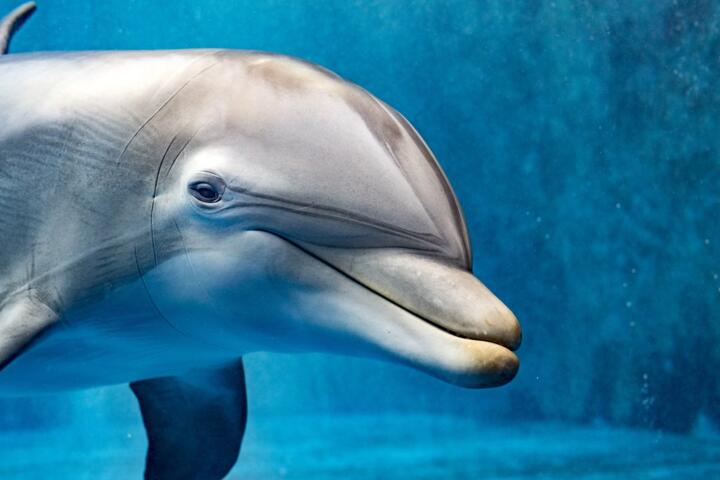
Dolphins are the clearest mammalian example. Classic recordings found about four hours of slow-wave sleep per hemisphere per day in bottlenose dolphins, with the two sides taking turns. A dolphin may keep swimming slowly, surface to breathe, and close one eye while the opposite hemisphere sleeps. The open eye is linked mainly to the more alert hemisphere through crossed visual pathways, so eye position gives researchers a useful behavioral clue, not a complete diagnosis.
Several birds show a related pattern called unihemispheric-monocular sleep. A duck can sleep with the eye facing a perceived threat open while the other eye closes. Great frigatebirds have even shown one-sided sleep during flight. This arrangement preserves some environmental monitoring, but it is not a free substitute for ordinary rest: a 2016 study measured only about 0.69 hours of sleep per day in flying frigatebirds.
Why Animals Use It
The pattern solves a practical conflict between sleep and survival. Dolphins must coordinate surfacing and breathing in an aquatic environment, while some seals need to rest in water without losing control of their body position. Birds may face predators, flock neighbors, or the need to keep flying. Sleeping one hemisphere at a time reduces the period when the whole animal is deeply disconnected from its surroundings.
Breathing deserves careful wording. Some older accounts treated dolphins as animals that must consciously wake for every breath. Later physiological work showed that their respiration can be automatic or under cortical control, and EEG studies showed that dolphins can breathe during unihemispheric slow-wave sleep. The safer conclusion is that one-sided sleep fits the demands of an aquatic life; it does not prove that every breath requires a fully awake brain.
Vigilance also comes in degrees. An open eye can detect movement and direction, yet it cannot recreate the full attention of an awake animal. In birds, sleep depth can differ between hemispheres, and the awake side may face outward from a flock. This behavior reflects risk management, not perfect protection. The animal still trades some sensory processing and responsiveness for recovery.
How To Study It
Start With Behavior
Researchers first record posture, movement, eye closure, surfacing, vocalization, and the timing of quiet periods. A bottlenose dolphin resting in a slow circle with one eye closed looks different from a dolphin cruising rapidly or responding to a trainer. Behavior narrows the candidate periods, but it cannot by itself prove that sleep occurred. Field observations of a porpoise making repeated quiet, parabolic dives therefore describe potential sleep rather than confirmed sleep.
Measure Both Hemispheres
EEG electrodes placed over the left and right cerebral hemispheres reveal the central pattern. During one-sided slow-wave sleep, one recording has synchronized, low-frequency waves while the other has a more wake-like signal. Researchers compare power, frequency, timing, and transitions rather than relying on a single spike. A short version of the method might resemble a two-channel audit: record both sides, align the traces, then test whether the asymmetry lasts long enough to match established criteria.
Track The Environment
Accelerometers, depth tags, video, eye observations, and respiratory records connect brain activity with the animal’s surroundings. In flying frigatebirds, head-mounted EEG and movement sensors showed sleep during circling flight and helped link the direction of a turn with the hemisphere that appeared more awake. In dolphins, swim speed and breath frequency help separate low-activity rest from active behavior. Each sensor answers a different question, so a strong study combines them.
Separate Rest From Sleep
Use cautious labels until the evidence lines up. Rest can mean reduced movement; sleep normally includes characteristic EEG changes, a higher sensory threshold, and a recurring biological pattern. One-eye closure is suggestive, not decisive, because an animal can close an eye while remaining alert. A good report states the species, setting, recording method, sample size, and uncertainty. That habit prevents a striking photograph from carrying more weight than the underlying measurements.
Animals That Use It
Toothed whales and dolphins show the most developed form known in mammals. Bottlenose dolphins can swim with one eye closed and alternate the side that exhibits slow waves. Porpoises and belugas have also entered the research record, although observations in wild animals are harder to interpret than controlled EEG studies. Manatees and some eared seals show asymmetric sleep as well, with the pattern changing according to conditions such as time spent in water.
Birds display more variation than the phrase “half-brain sleep” suggests. Ducks may sleep asymmetrically when positioned at the edge of a group, directing the open eye toward the exposed side. A bird in the center can sometimes sleep with both hemispheres because flock mates cover the perimeter. The response is flexible: social position, threat level, and the side facing outward can change the pattern.
Great frigatebirds demonstrate a second trade-off. They can sleep during long flights, using one hemisphere or both, but their total sleep in the air is strikingly small. During turns, the hemisphere opposite the direction of the turn may show lower slow-wave activity, consistent with an eye facing into the flight path. The finding shows that sleep can coexist with flight control, not that flight is unaffected by sleep loss.
Fur seals add a useful comparison. They can switch between bilateral and unihemispheric sleep depending on whether they are on land or in water. That flexibility suggests the behavior is not a single fixed switch shared identically by all species. The same broad pattern can serve breathing, body control, vigilance, or movement, with different costs in each setting.
A Practical Comparison
The table below compares the evidence and trade-offs across familiar examples. “Evidence” refers to the kind of observation that supports the sleep interpretation; it does not imply that every individual in a species behaves identically.
| Animal | Main pressure | Evidence | Trade-off |
|---|---|---|---|
| Bottlenose dolphin | Breathing and swimming | Bilateral EEG, alternating eye closure | Some movement continues during sleep |
| Duck | Perimeter vigilance | One eye and asymmetric sleep signals | Sleep posture and group position matter |
| Frigatebird | Flight awareness | EEG and movement tags in flight | Very little sleep recorded aloft |
| Fur seal | Water versus land | State changes across habitats | REM sleep patterns can differ |
Common Mistakes
The first error is treating “half the brain” as a literal split through every neural process. EEG describes activity in sampled cortical regions; it does not show that one side is entirely off. Subcortical circuits, spinal pathways, breathing muscles, and balance systems may operate across the whole body. A precise explanation says that sleep-like cortical activity is stronger on one side.
The second error is using a single open eye as proof. Eye closure can vary with light, posture, social behavior, or observation angle. Conversely, an animal can show asymmetric EEG without a clearly visible eye difference. Researchers gain confidence when behavior, EEG, movement, and context point to the same episode.
A third mistake is generalizing from dolphins to every animal that rests near water. Unihemispheric sleep has been documented in selected cetaceans, eared seals, manatees, and birds, but the pattern, duration, and function differ. A fourth is assuming that sleep in flight means birds obtain normal sleep. Frigatebird recordings argue for the opposite caution: the ability to sleep aloft did not produce a typical nightly total.
Finally, avoid turning an adaptation into a human sleep tip. People do not gain a dolphin-like ability by sleeping with one eye open, changing position, or using an alarm. Human sleep remains a coordinated whole-brain state, and interrupted rest is not equivalent to measured unihemispheric slow-wave sleep.
FAQ
Do dolphins sleep with one eye open?
Often, yes. During unihemispheric sleep, one eye may close while the eye linked with the more alert hemisphere remains open, but eye position alone cannot confirm sleep.
Can animals swim while sleeping?
Some dolphins can maintain slow, coordinated swimming during one-sided sleep. The behavior relies on neural and motor systems that remain active while one hemisphere shows slow waves.
Do birds sleep while flying?
Great frigatebirds have been recorded sleeping during flight, including one-sided and two-sided episodes. Their measured sleep time aloft was much lower than sleep time on land.
Is unihemispheric sleep deep sleep?
It includes slow-wave sleep in the sleeping hemisphere, but depth can differ between sides and the animal retains some wake-like functions.
Why does one eye stay open?
The open eye can watch a threat, flock edge, or flight direction through the hemisphere that remains more alert. It supports vigilance but does not recreate full waking awareness.
Author's Insight
Unihemispheric sleep is best read as a trade-off between recovery and continued control, not as a superpower that removes the cost of sleep. The strongest evidence combines EEG with behavior and environmental measurements, because no single visible sign captures the whole state. Species differ because breathing, movement, flock position, and predation create different pressures. The frigatebird result is a useful warning that retaining some alertness may still leave an animal with very little total sleep.
Key Takeaways
Some dolphins, seals, manatees, and birds can sleep with one cerebral hemisphere showing slow-wave activity while the other remains more alert. One-sided sleep can support breathing, swimming, flight, or threat monitoring, and an open eye may accompany it. EEG is the deciding evidence; posture and eye closure are clues. The arrangement reduces vulnerability, yet it does not erase sleep’s limits. Read claims by species, habitat, measurement method, and the difference between quiet rest and confirmed sleep.