Lunar Dust Exposure Risks
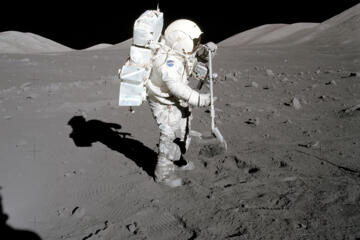
Lunar dust refers to fine regolith particles generated by impacts and surface operations on the Moon. Its particle size distribution includes very small grains that can cling to surfaces and spread through airlocks, suit joints, and habitat ventilation paths. Apollo-era reports described dust that adhered to fabrics and left a persistent “powder” layer, which matters because repeated contamination increases the chance of inhalation and eye irritation. The health concern is not limited to a single dramatic event; it is the cumulative effect of repeated low-level exposure over days to months.
Two properties drive most of the risk. First, lunar dust is abrasive, so it can damage seals and increase leakage pathways, which then raises the chance that particles reach breathing zones. Second, lunar dust can become electrostatically charged in the lunar environment, which helps it stick to suit materials and then migrate when astronauts move. A third factor is chemical reactivity: some particles contain reactive components formed by space weathering, and those can interact with moisture and biological tissues. The exact hazard level varies by particle chemistry and mission conditions, and evidence from Earth-based tests does not perfectly match lunar gravity, vacuum, and radiation.
Main Problems And Pain Points
People often underestimate how dust exposure happens in practice. A common misconception is that dust exposure requires direct contact with the lunar surface. In reality, dust can be transported inside habitats through suit transfer, then redistributed by airflow, fans, and pressure cycling. Even if the habitat air is filtered, small leaks around suit ports, maintenance hatches, and docking interfaces can create localized contamination.
Another frequent error is treating lunar dust as “like beach sand.” Regolith grains include sub-micron particles that behave differently from larger grit: they can remain suspended longer, penetrate deeper into airways, and cling to wet surfaces. Inhalation risk depends on particle aerodynamic diameter, breathing rate, and whether dust is agglomerated or dispersed. Eye and skin irritation also depend on whether particles are dry and electrostatically attracted to moisture films on the ocular surface or skin.
Supporting technologies shape the exposure profile. Suit design determines how dust is captured or expelled during doffing, and airlock procedures determine how much dust enters the habitat. Filtration systems depend on filter media loading and maintenance schedules; a filter that works well at the start of a mission can degrade as it accumulates fine particles. Habitat pressure control matters too: pressure differentials during ingress and egress can move particles from suit volumes into living spaces. I once saw a training checklist version labeled “Rev. 3.2” that focused heavily on suit cleaning steps but gave less detail on what to do when dust alarms triggered—small gaps like that can matter.
Solutions And Advice
Control Dust Pathways
Start by mapping the dust pathway rather than only the dust source. For mission planning, teams typically treat suit donning, EVA (extravehicular activity) operations, doffing, and airlock cycling as linked stages that each add contamination risk. A practical method is to define “clean-to-dirty” zones in the habitat and enforce physical separation so that contaminated surfaces do not contact breathing-air handling equipment. Realistic outcome targets depend on system design, but teams often aim for measurable reductions in airborne particle counts in crew areas after each transfer cycle, using onboard particle counters and periodic surface sampling.
Operationally, astronauts can reduce dust spread by minimizing unnecessary suit movement during doffing and by following stepwise cleaning sequences that remove dust before it contacts interior fabrics. The exact sequence varies by suit architecture, but the logic is consistent: remove loose particles early, then address residual films. If a mission uses a vacuum-assisted suit cleaning station, the effectiveness depends on nozzle placement, suction power, and how dust is loosened from seams. A minor frustration: checklists sometimes assume perfect dust removal, while real dust can cling to micro-textures and Velcro-like closures.
Use Filtration With Monitoring
Air filtration reduces inhalation risk, but it does not remove the need to prevent dust entry. Fine particles can load filters quickly, raising pressure drop and changing airflow patterns. Teams can manage this by selecting filter media rated for fine particulate capture and by tracking differential pressure and particle counts over time. A practical approach is to schedule filter inspections based on measured loading rather than fixed calendar intervals, because dust influx can spike after high-EVA days.
For medical risk management, monitoring should include both environmental and symptom signals. Environmental sensors can flag increases in particulate concentration, while crew reporting can capture early irritation signs. The medical team can then decide whether to adjust ventilation settings, pause certain activities, or trigger additional cleaning cycles. On Earth, particle counters often show “spikes” after door cycling; lunar missions can see similar patterns, just with different particle behavior.
Reduce Electrostatic Adhesion
Electrostatic charging helps lunar dust stick to surfaces, so mitigation focuses on controlling charge buildup and improving surface cleanability. Engineers test suit fabrics and coatings for their tendency to attract or repel charged particles, and they evaluate how dust behaves after repeated charging cycles. Some concepts use conductive pathways, grounding strategies, or surface treatments that reduce static attraction. The health relevance comes from reducing dust migration into breathing zones and lowering the amount of dust that must be removed during doffing.
In practice, mitigation is limited by tradeoffs: conductive materials can affect comfort, thermal management, and flexibility, and coatings can wear. A realistic expectation is that no material stops dust adhesion completely; the goal is to reduce the fraction of dust that transfers from suit exterior to interior surfaces. Testing results from analog environments can guide design choices, but lunar-specific conditions—vacuum, radiation, and dust charging—still create uncertainty.
Plan Medical Response For Irritation
Medical planning should treat dust exposure as a spectrum of effects: eye irritation, skin inflammation, and respiratory symptoms. Protocols can include baseline assessments before EVA cycles, symptom checklists after EVA days, and clear thresholds for when to seek evaluation. Because lunar dust composition varies, clinicians should avoid assuming that every regolith sample produces the same response. Instead, medical teams can link symptoms to exposure logs and environmental measurements.
On Earth, clinicians use history, physical exam, and sometimes imaging or pulmonary function tests to evaluate respiratory irritation. For space missions, constraints on equipment mean that early symptom tracking and conservative decision-making often matter more than advanced diagnostics. If a crew member reports persistent cough, wheezing, or worsening shortness of breath after dust exposure, the response plan should include work restrictions and additional environmental checks. The exact thresholds depend on mission medical capability and crew health status, and those details are mission-specific.
Case Examples From Mission Planning
Scenario 1: Post-EVA Habitat Contamination Spike. An anonymized crew completes two EVAs in a single day. Particle counters in the habitat show a short-lived rise in fine particulate concentration after airlock cycling, and surface swabs from a common handrail area show elevated dust residue. The team pauses nonessential movement in that zone, increases cleaning frequency, and checks for seal wear in the suit transfer interface. Over the next EVA cycle, the spike becomes smaller, suggesting that a procedural change—slower doffing and earlier external brushing—reduced dust carry-in.
Scenario 2: Persistent Eye Irritation After High-Dust Operations. Another anonymized mission logs repeated reports of mild eye burning after a day with extensive regolith sampling. Environmental sensors show no major airborne increase, but the crew reports that dust was visible on suit cuffs and gloves during doffing. The medical team correlates symptoms with doffing steps and identifies a missed cleaning stage in the checklist. After retraining and adding a verification step using a handheld inspection light (a tool crews often use for seam checks), symptoms decline over subsequent cycles.
Comparison Table And Checklist
Use the table to compare mitigation approaches by what they reduce and what they cannot fix.
| Approach | Primary Risk Reduced | Key Limitation | What To Check |
|---|---|---|---|
| Airlock and doffing procedure | Dust carry-in to habitat | Human steps vary; missed stages happen | Step completion logs; post-doff surface swabs |
| Suit cleaning station | Loose dust removal before interior contact | Effectiveness depends on dust loosening and suction coverage | Measured residue reduction; maintenance intervals |
| Habitat filtration | Inhalation exposure from airborne particles | Filter loading changes performance over time | Differential pressure trends; particle counts after cycling |
| Medical symptom thresholds | Early detection of irritation and respiratory effects | Limited diagnostics in space; symptoms can be nonspecific | Exposure logs; follow-up exams; work restrictions |
Checklist for evaluating a dust-mitigation plan:
- Does the plan describe dust pathways from suit exterior to habitat breathing zones, not only surface contact?
- Are there measurable environmental targets (particle counts) and maintenance triggers (filter loading or pressure drop)?
- Does the plan include verification steps during doffing, not only “perform cleaning” instructions?
- Are medical response thresholds tied to exposure logs and symptom patterns after EVA days?
- Does the plan address what happens when sensors show unexpected spikes, which crews often experience during airlock cycling?
Common Mistakes
A frequent mistake is focusing on dust “toxicity” as a single number. Lunar dust risk includes mechanical effects (abrasion), physical behavior (suspension and adhesion), and exposure routes (inhalation, eye contact, skin contact). A plan that only discusses chemical toxicity misses the practical pathway that drives exposure.
Another mistake is assuming that filtration alone solves the problem. If dust enters the habitat, filtration reduces airborne concentration but does not prevent surface contamination. Dust on surfaces can later become airborne again when disturbed, and it can contaminate equipment that crew members touch near their face. A third mistake is treating checklists as static documents; procedures often require revision after operational feedback, and a “Rev. 1” procedure can lag behind real failure modes.
People also overstate certainty about health outcomes. Evidence from Earth-based dust simulants and animal or cell studies can show irritation or inflammation patterns, but translating those results to lunar mission conditions involves uncertainty in particle size, charging state, and exposure duration. A careful evaluation separates what tests show from what missions can measure, then designs monitoring to close the gap.
FAQ
Can Lunar Dust Cause Lung Damage?
Lunar dust exposure can irritate airways and may contribute to inflammatory responses, but the exact likelihood and severity depend on particle size distribution, exposure duration, and dust chemistry. Mission plans therefore rely on environmental monitoring and symptom tracking rather than assuming a single outcome.
Why Does Dust Stick To Suits?
Lunar dust can become electrostatically charged in the lunar environment and then adhere to materials, especially where micro-textures trap particles. Suit grounding strategies and surface material choices aim to reduce charge-driven adhesion, yet adhesion rarely drops to zero.
Do Air Filters Remove All Dust?
Air filters reduce airborne particles, but they do not stop dust from settling on surfaces or re-aerosolizing during movement. Filter performance can also change as media loads with fine particles, so monitoring and maintenance triggers matter.
What Symptoms Would Crew Notice First?
Early signs often include eye burning, throat irritation, cough, or a sensation of dryness after EVA days. Symptoms can be nonspecific, so teams correlate reports with exposure logs and particle counter readings to avoid guesswork.
How Do Missions Test Dust Mitigation?
Teams use a mix of dust simulants, material tests, airflow and filtration trials, and procedure rehearsals in analog environments. Results guide design choices, but lunar-specific charging and vacuum conditions create uncertainty, so monitoring during real operations remains part of the safety case.
Author's Insight
Lunar dust risk is best treated as an exposure-route problem rather than a single “chemical hazard.” The strongest practical lessons come from how dust migrates through suit interfaces, airlocks, and habitat airflow, then reappears when surfaces are disturbed. Evidence from analog testing and historical mission reports supports concerns about adhesion, abrasion, and irritation, but translating lab findings to mission outcomes requires caution. A defensible safety approach combines engineering controls, measurable environmental monitoring, and medical response thresholds tied to exposure logs—then revises procedures when sensor data disagrees with expectations.
Key Takeaways
- Lunar dust threatens astronauts through multiple routes: inhalation, eye irritation, skin contact, and contamination of habitat surfaces.
- Dust behavior depends on particle size, charging, and how operations move particles from suit exterior to breathing zones.
- Filtration reduces airborne exposure but does not eliminate surface contamination or re-aerosolization.
- A credible mitigation plan includes measurable targets, maintenance triggers, and a medical response tied to exposure logs.
- Uncertainty remains because Earth tests cannot perfectly reproduce lunar vacuum and dust charging, so monitoring and procedure updates matter.