Lunar Gravity And Motion
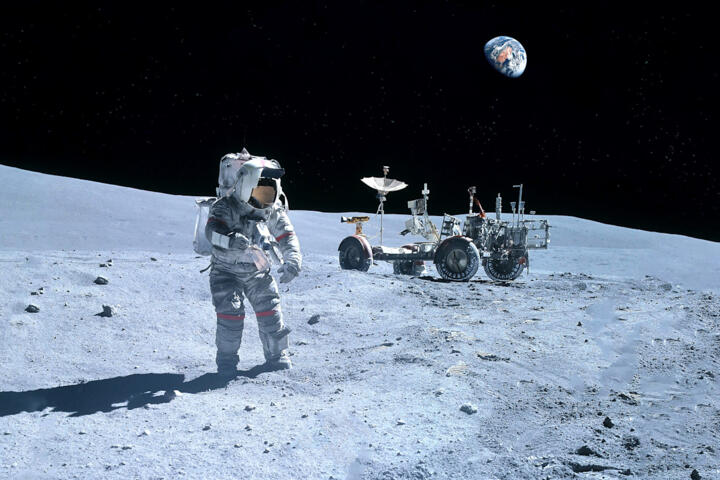
Lunar gravity is roughly 1.62 m/s², about 1/6 of Earth’s 9.81 m/s². That change alters how forces build up during walking, jumping, and sudden stops, because the body’s weight and the friction demands on the suit and boots shift together. Astronauts also face a vacuum environment, so there is no air resistance to damp motion, and dust can affect footing. On the Moon, a small misstep can turn into a longer slide or a higher bounce than expected, which is why movement training focuses on timing and control rather than speed.
Adaptation starts with the physics of contact. With lower weight, the same leg push produces more acceleration, and the body tends to “float” longer during each step. At the same time, the suit adds mass and stiffness at the joints, changing how quickly astronauts can reposition their center of mass. The result is a gait that often looks like a careful, short-stride walk with deliberate foot placement, plus controlled crouches when approaching slopes or uneven regolith.
Real missions also show that adaptation is not only about walking. Tasks like sampling, tool use, and operating a rover depend on stable posture under load. When an astronaut leans to reach a surface, the reduced gravity changes the balance response, and the suit’s mechanical constraints can make fine corrections slower than on Earth. That is why crews practice task sequences in environments that mimic suit mass, mobility limits, and partial-gravity movement cues, not just treadmill walking.
Common Misconceptions And Dependencies
People often assume that “one-sixth gravity” means astronauts will simply move more easily. The opposite can happen: reduced weight can increase the tendency to overshoot, and the suit can make it harder to brake. Another misconception treats partial gravity as a single variable, when the real challenge combines gravity, suit mechanics, surface friction, and task timing. Regolith can behave like a low-friction granular material, and dust can reduce traction or clog boot tread, which changes how stopping works.
Training depends on supporting technologies that reproduce the right cues. Neutral buoyancy systems in water reduce effective weight, but they do not reproduce the Moon’s vacuum, dust, or suit pressurization dynamics. Parabolic flights create brief partial-gravity periods, yet the time window is short and the motion environment differs from lunar surface walking. Ground-based simulators can reproduce suit mass and joint resistance, and some facilities use harnesses or treadmills to control fall risk, but they still cannot fully match the Moon’s contact mechanics.
Even the measurement side has dependencies. Astronauts monitor posture and movement using onboard sensors and suit telemetry, but the feedback loop is constrained by communications delays and by the fact that many adjustments must be made by feel. A crew member may notice that a step “feels” different, then later confirm with data that stride length, trunk angle, or joint loading shifted. That gap between perception and measurement is one reason training emphasizes repeatable procedures rather than relying on intuition alone.
Training And Operational Advice
Practice Controlled Foot Placement
Use training drills that prioritize where the foot lands and how quickly the body settles after contact. In suit-mobility sessions, crews often rehearse short steps, deliberate heel-to-toe placement, and pauses to re-center the torso before reaching. A practical outcome to aim for is fewer “correction steps,” meaning fewer extra foot placements needed to regain balance after a misaligned step. In one common training pattern, astronauts repeat a route with marked targets and time the sequence, then repeat it with the same targets but altered terrain height to force consistent braking habits.
Ground friction matters, so trainees learn to treat the surface as variable. If the boot tread is dusted or if the regolith is looser, stopping distance can increase. That is why procedures often include slowing before turns and avoiding abrupt hip twists while the feet are still “settling.” A small aside from training logs: instructors frequently note that people who rush the first step tend to overcorrect on the second, which is when falls become more likely.
Rehearse Suit-Driven Joint Limits
Adaptation includes learning how the suit changes joint motion and how that affects balance. Crews practice reaching, crouching, and tool handling with the same suit they will wear on mission, because the suit’s stiffness and pressurization affect range of motion and the timing of muscle activation. A realistic target is smoother transitions between standing and crouching, measured by fewer abrupt posture changes and fewer “re-grips” on tools. Training often uses checklists for body mechanics: set stance first, then reach, then confirm tool alignment before applying force.
Joint limits also influence how astronauts carry loads. When a tool or sample container shifts weight, the center of mass moves, and in low gravity the body may not settle as quickly. Crews therefore rehearse load transfers in slow sequences, then gradually increase speed while keeping the same posture cues. A mild frustration that shows up in many training debriefs: people can perform a movement perfectly in a slow demo and then lose control when the task is timed, because timing changes how the body brakes.
Use Simulators With Clear Limits
Choose training methods that match the specific skill being practiced. Neutral buoyancy helps with general movement rehearsal and fall recovery practice, but it can mask the feel of weight-bearing and friction. Parabolic flights can teach partial-gravity coordination, yet they do not replicate lunar surface contact. For surface walking, crews rely on ground-based partial-gravity analogs and controlled terrain, often combined with motion capture to compare stride parameters.
When reviewing training outcomes, compare metrics that reflect control rather than speed. Examples include stride regularity, time spent in “double support” phases, and the number of corrective steps after a target is missed. If a simulator shows good performance but the astronaut still struggles during suit-walk tests, the mismatch likely comes from contact mechanics or suit pressurization effects, not from balance alone.
Plan Procedures For Slopes And Dust
Operational advice focuses on reducing the chance of uncontrolled sliding or bouncing on uneven ground. Crews rehearse approaches to slopes with conservative body angles and deliberate foot placement, because the combination of lower weight and surface irregularities can amplify lateral motion. Dust adds another layer: it can change traction and can also affect how boots and tools “seat” into the ground during sampling.
Procedures often include slowing before slope transitions, using stable stances for tool application, and avoiding sudden torso twists while feet are planted. A realistic outcome is fewer interruptions to task flow, such as fewer times the astronaut must stop to clear dust from boot tread or to re-seat a tool. In training, instructors sometimes mark “no-go” zones where regolith is known to be loose, because the risk profile changes quickly with surface conditions.
Case Examples From Training Scenarios
Scenario: Overshoot During a Sample Walk
An anonymized crew member rehearses a route to a sampling site in a suit-mobility facility. During the first run, the astronaut takes longer steps than planned and ends up overshooting the target by a few feet, then uses extra corrective steps to regain balance. In the debrief, the team notes that the astronaut’s trunk re-centering happened late, so the second step landed while the body was still rotating. The fix is a revised sequence: short step, pause to re-center, then approach the target with a controlled braking step. After repeating the drill, the number of corrective steps drops, though the astronaut still reports that the “feel” of braking differs from Earth.
Scenario: Tool Handling Under Load Shift
Another anonymized trainee practices drilling and sample bagging while carrying a loaded container. The first attempts show stable posture while standing, but balance degrades during the transition to a crouch because the container shifts slightly and the suit resists rapid joint motion. The training team changes the procedure: set stance first, crouch with smaller increments, then confirm container position before applying drilling force. Motion capture in the facility shows reduced trunk sway during the crouch phase. The trainee still needs more time than on Earth, yet the task sequence becomes more repeatable, which matters when real mission time is constrained.
Checklist: Adaptation Factors To Compare
| Factor | What Changes In Low Gravity | What Training Tries To Reproduce | Common Failure Mode |
|---|---|---|---|
| Walking and stopping | Longer “settling” after foot contact; overshoot risk | Short-step drills; target-based routes; controlled braking | Rushing the first step, then overcorrecting |
| Suit mobility | Joint stiffness and delayed fine corrections | Reaching, crouching, and tool handling in the actual suit | Late posture re-centering during transitions |
| Surface friction | Stopping distance and traction vary with regolith and dust | Terrain analogs; boot tread checks; slope rehearsals | Assuming Earth-like braking on loose ground |
| Task timing | Coordination degrades when speed increases | Repeatable sequences with metrics beyond speed | Performing well in demos, failing under time pressure |
Use this checklist to compare training plans. If a plan claims “partial gravity walking practice” but does not specify how it handles suit stiffness and surface friction, the training gap usually shows up during tool use rather than during simple steps.
Common Mistakes To Avoid
One frequent mistake is treating lunar adaptation as a single adjustment to balance. Balance depends on joint range, suit pressurization, and how the body brakes after each contact. Another mistake is over-relying on neutral buoyancy sessions; trainees can become confident in movements that feel easy in water but harder on a dry, dusty surface. A third mistake is skipping slope and uneven-terrain rehearsals, then discovering that lateral motion control is the real limiter.
People also misread performance metrics. A fast route can hide instability if the astronaut uses extra corrective steps or if posture re-centering happens after the target interaction. In some training reviews, teams track “time to stable posture” after each step, which catches problems that speed alone misses. A minor aside: some facilities label motion-capture runs with internal tags like “v3.2” to distinguish calibration sets, and those tags matter because sensor drift can change the apparent stride pattern.
Finally, avoid assuming that adaptation happens instantly. Crews build repeatability through repetition, and the first attempts often show inconsistent braking and delayed corrections. That pattern is not a sign of failure; it is a sign that the body is learning a new set of force cues. The goal is to reduce variability enough that task performance stays predictable under mission constraints.
FAQ
How much weaker is lunar gravity?
Lunar surface gravity is about 1.62 m/s², which is roughly one-sixth of Earth’s 9.81 m/s². That ratio drives changes in walking, jumping, and stopping behavior.
Do astronauts float on the Moon?
Astronauts do not float like in microgravity, but they can experience longer “hang time” during steps and jumps because their weight is lower. The suit and surface contact still constrain motion.
Why does the suit change walking on the Moon?
Spacesuits add mass and stiffness at joints and limit range of motion. Those effects slow fine balance corrections and change how quickly an astronaut can brake after foot contact.
What training methods help with partial gravity?
Training commonly combines suit-mobility practice on Earth, motion-capture feedback, and partial-gravity analogs such as neutral buoyancy and parabolic flights. Each method reproduces some cues and misses others.
Can astronauts adapt after arriving on the lunar surface?
They adapt during the mission through repeated task cycles, but early performance can be inconsistent. Mission procedures often assume a learning curve and build in conservative movement and task sequencing.
Author's Insight
Adaptation to lunar gravity is best understood as a control problem: the body must learn new relationships between muscle effort, joint motion, and ground reaction forces. The Moon’s reduced gravity changes the timing of posture settling, while the suit changes joint mechanics and the friction environment changes braking. Training methods target these specific components rather than treating “gravity” as a single variable. Evidence from human factors and spaceflight training shows that repeatability and procedure discipline matter because perception of stability can lag behind sensor-measured motion.
Key Takeaways
- Lunar gravity lowers body weight, which increases overshoot and changes stopping behavior, especially on dusty or uneven ground.
- Spacesuits alter joint range and stiffness, so balance corrections can be slower than on Earth.
- Training works best when it targets foot placement, posture transitions, and tool-handling sequences under suit constraints.
- Simulators reproduce some cues and miss others; compare training claims against how they handle suit mechanics and surface friction.
- Common failures come from rushing, skipping slope/terrain rehearsals, and using speed metrics that hide instability.